
A bass boat, day cruiser and sailboat need different kinds of onboard power. One buyer may prioritize trolling motor runtime; another needs a house bank that supports overnight loads. This guide compares marine lithium battery manufacturers by the jobs their products address, with an emphasis on boatbuilders, battery brands and distributors seeking dependable supply.
How We Selected These Manufacturers
We considered published recreational marine applications, identifiable battery products and evidence of battery design or manufacturing capability. Brands owned by one company are counted together. This is an editorial shortlist, not a verified ranking by revenue, output or independently tested performance.
SAFTEC is listed first because we publish this guide and specialize in made-to-specification OEM battery packs.
Marine Lithium Battery Manufacturers to Know
SAFTEC — Custom Packs for OEM Programs
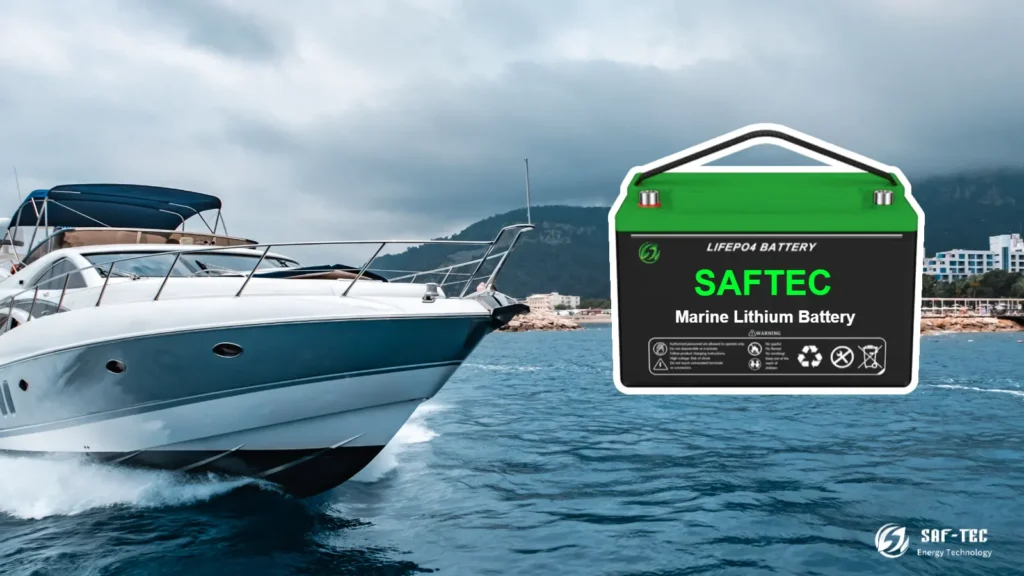
SAFTEC develops LiFePO4 marine battery packs from a customer’s drawing, existing battery or target specification. Boatbuilders and battery brands can define voltage, capacity, BMS current, dimensions, terminals and labeling, then approve a sample before repeat production. Complete and cell-ready packs are available for suitable projects. This is a route for batch supply, rather than one-off retail replacement. See our marine lithium battery capabilities.
RELiON — Fishing Boat Battery Range
RELiON publishes marine LiFePO4 options for bass boats, saltwater fishing, trolling motors and onboard electronics, including a dedicated 36V trolling battery. It also describes OEM partnership programs. Its range makes it relevant to buyers comparing batteries for different fishing-boat circuits. Confirm the intended duty of the specific battery: a marine label does not mean every model can also start an outboard.
Dragonfly Energy — Battle Born and Dakota Lithium
Dragonfly Energy assembles lithium battery packs and markets Battle Born for marine use. In 2026 it acquired substantially all the operating assets associated with Dakota Lithium, which it intends to retain as a distinct brand. These are two brands within one manufacturer entry, not two independent companies. Compare their individual products for the proposed boat and buying channel rather than treating the brand names as interchangeable.
Super B — Leisure Marine Power
Super B says it engineers and produces lithium batteries in the Netherlands. Its leisure-marine offering spans onboard power and electric-boat applications, with published small-boat and sailing examples. It suits buyers comparing a battery platform for a vessel, especially when space, charging and system layout matter. A compact house battery and a propulsion bank must still be specified as different duties.
Mastervolt — Marine Electrical Integration
Mastervolt offers lithium-ion batteries alongside chargers, inverters and marine electrical controls. Its leisure-marine focus is useful for cruising boats where the house bank must work with the rest of the onboard system. When comparing proposals, check whether the scope includes only batteries or also the equipment and settings needed to charge and manage them.
Victron Energy — Batteries and System Components
Victron supplies lithium batteries, BMS options, chargers and monitoring products for marine installations. Its small-boat guidance addresses house power for onboard electronics. Victron equipment already installed on a boat does not automatically validate an unrelated battery: communication, charging settings and protection behavior must be checked for the proposed combination.
Lithionics — Engineered Battery Systems
Lithionics designs and assembles lithium battery systems in Florida and publishes marine applications alongside BMS and charging components. Its emphasis on system engineering makes it relevant to boats with larger house loads or more complex power architectures. Buyers should compare the battery specification and the complete system scope separately when requesting proposals.
Match the Battery to Its Job on Board
On a bass boat, trolling motors, electronics and outboard starting can demand different battery characteristics. Trolling calls for the motor’s required voltage and sustained current; electronics need an appropriate supply; starting requires an approved battery and charging arrangement. Specify each duty before selecting a pack.
A cruiser or sailboat may instead need a house bank sized for refrigeration, lighting, navigation and time away from shore power. In either case, compare usable energy, current, installation space and charging sources, not Ah alone.
For the fishing-boat side, see our bass boat brand overview and lithium trolling motor battery guide. For a production project, explore our trolling motor battery options.
Discuss a Custom Marine Battery Project With SAFTEC
If you source batteries for a boat line, marine equipment range or private-label program, contact SAFTEC with a drawing or existing battery, its intended onboard job and approximate order volume. If the design is still open, share the target voltage, runtime, available space and charging method.
We can review the battery scope, develop a proposed configuration and confirm a sample before repeat batch production. The goal is a defined specification your team can order consistently.
Frequently Asked Questions
Can a standard deep-cycle LiFePO4 battery start an outboard?
Do not assume so. Starting needs suitable peak current, BMS behavior and compatibility with the engine and charging system. Check the battery and engine manufacturers’ requirements for the intended installation.
Can marine LiFePO4 batteries be charged below freezing?
It depends on the pack. Some BMS designs block charging when the cells are cold; others include heating. Confirm the battery’s permitted conditions against the boat’s winter use.
Does an IP rating alone make a battery suitable for a boat?
No. An IP rating addresses defined enclosure protection. Mounting position, terminals, vibration, wiring and exposure in the actual boat still need review.
How should OEM buyers control changes between battery batches?
Agree on a sample and specification, then ask the supplier how it records production revisions, testing and pack identification. This gives both teams a reference when the same design is reordered.