
Rack batteries are modules designed for equipment racks and cabinets. Often called server rack batteries, they serve solar storage, UPS backup and telecom DC systems. The same name does not guarantee the same electrical interface. For OEMs, integrators and distributors, a useful supplier can document the fit and repeat an approved design across batch orders. These seven manufacturers show different approaches to that requirement.
How We Selected These Manufacturers
We included companies with published information on rack-format or cabinet-integrated lithium batteries and an identifiable product or supply role. SAFTEC appears first because it publishes this article and serves custom B2B projects. Buyers should confirm specifications for the exact model under consideration.
Rack Battery Manufacturers to Know
SAFTEC — Custom Batteries for OEM Projects
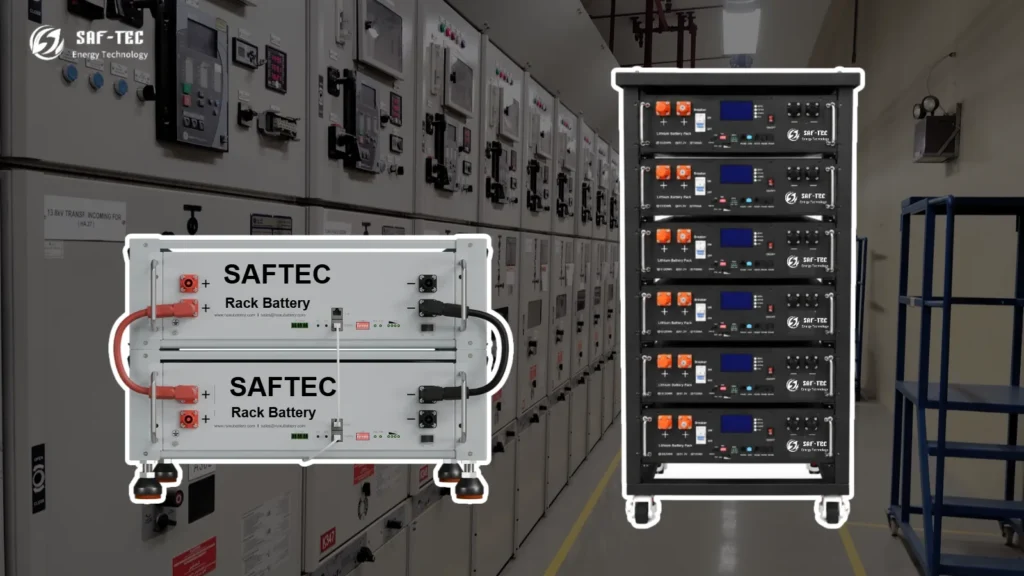
SAFTEC supplies 48V and 51.2V LiFePO4 rack battery modules for energy storage, UPS and telecom projects. Its 50–200Ah capacities are reference configurations, not a list of stocked products. OEM customers can discuss enclosure dimensions, front-panel layout, BMS communication and connections against their equipment drawings. Samples or pilot orders help establish an approved design before batch production. This approach suits equipment builders and distributors that need a repeatable specification. See SAFTEC’s rack battery capabilities.
Pylontech — Modular Energy Storage
Pylontech’s US5000 is a 48V LFP module rated at 4.8kWh and described as compatible with a 19-inch rack. It provides a reference for scalable solar and stationary storage. Buyers still need to verify rack depth, inverter pairing and configuration limits for their installation. A module selected for an energy storage inverter cannot automatically replace a battery in a telecom DC system.
Pytes — Modules and Enclosures
Pytes offers low-voltage server rack batteries, including the E-BOX 48100R family and matching enclosure options. Its published arrangements show how modules can be combined with cabinet hardware and electrical protection for an energy storage project. This matters when comparing quotations: a battery-only price and a cabinet-level proposal do not cover the same equipment or installation work.
LEOCH — Documented Cabinet Fit
LEOCH lists rack-mounted LiFePO4 batteries with 19-inch dimensions and 3U or 4U heights, including 51.2V models. It also offers telecom-focused lithium batteries. Evaluate those product lines for their respective applications, even when their enclosures look similar. Request the full mechanical drawing: rack width and height alone do not establish depth, rail fit, airflow or access to the front connections.
BSLBATT — Model-Level Specifications
BSLBATT’s B-LFP48-200E server rack model lists a 51.2V nominal voltage and 10.24kWh nominal energy. The “48” in its name is a useful reminder to read the datasheet rather than infer electrical fit from a product label. Its published dimensions and documents permit a model-level comparison. Ask which test and certification records apply to the exact unit offered for your destination market.
Discover Energy Systems — Rack Battery Components
Discover Energy Systems offers AES RACKMOUNT battery modules together with matching rack, combiner and cable options. Its product information separates those components, helping integrators see what is required beyond the battery module. It is a useful comparison for projects where cabinet assembly and connections affect the final supply scope. Confirm the approved enclosure and inverter configuration rather than assuming every combination carries the same documentation.
Narada Power — Telecom Backup
Narada Power’s NPFC series comprises 48V LiFePO4 modules for communications backup. Its documentation addresses interaction with telecom power plants and applications such as access networks and base stations. This belongs in a rack battery comparison because telecom DC is a distinct procurement case. Its charging and control requirements should not be assumed identical to those of a module marketed for residential solar storage.
What B2B Buyers Should Compare
Compare proposed modules against the same equipment and project scope, rather than price per kWh alone:
| Item | Confirm before approval |
|---|---|
| Mechanical fit | Width, U height, depth, mounting, ventilation and front access. |
| Electrical fit | Operating and charging ranges, usable energy, continuous current and peak current. |
| Integration | The actual BMS protocol supported by the inverter, UPS or rectifier, not merely a CAN or RS485 socket. |
| Expansion | Approved parallel count, protection and module-matching rules. |
| Included supply | Whether the offer includes modules, cabinet, breakers, cables, labels and model-specific documents. |
A “48V rack battery” label cannot confirm charging compatibility. Likewise, server rack describes an installation format; it does not mean the module directly powers servers. Compare the complete proposed configuration. If your project calls for a wider residential system, explore SAFTEC’s home storage battery solutions.
Discuss a Custom Rack Battery Program With SAFTEC
SAFTEC builds project-based LiFePO4 packs for OEMs, system integrators and distributors. Share your equipment model or drawing, intended use, available cabinet space and expected batch volume. Include electrical or communication requirements if you have them; the team can identify what still needs confirmation. A sample or pilot build can precede repeat production to an agreed specification. Review the rack battery options or contact SAFTEC to discuss a manufacturing program.
Frequently Asked Questions
Can we start with a pilot before placing a bulk order?
SAFTEC supports samples or pilot orders for suitable projects. Agree on the drawing, electrical settings and acceptance checks so the approved version can guide batch production.
Can the front panel and labels carry our brand?
OEM enclosure layout and labeling can be discussed. Supply artwork and identify interface positions before approving the drawing; branding does not remove the need for electrical validation.
What if the connected equipment receives a firmware update?
Keep the tested equipment and battery software versions on record. Check whether an update changes communication or charging behavior before applying it across a production program.
Is there a standard MOQ for every custom rack battery?
Order requirements depend on the agreed design and production scope. Request a quotation that distinguishes pilot needs from planned batch volumes and states any tooling or documentation costs.