
The best golf cart brand depends on your use: golf, resort transport, or neighborhood travel. For an electric cart, the battery also shapes long-term costs. Here are ten brands, their powertrain options, and the questions to ask before a lithium battery upgrade.
Selection: Each brand has a documented electric cart. This is an editorial list, not a sales or reliability ranking. We checked official model pages in October 2026; availability varies by market.
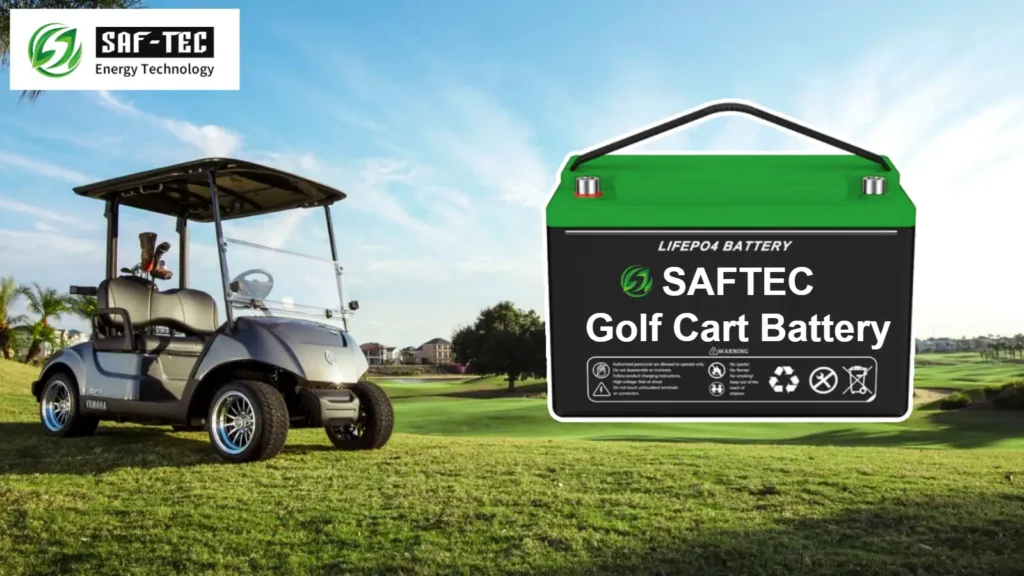
Gas vs. Electric Golf Carts: Do Both Need Batteries?
Yes, for different jobs. A gas golf cart typically uses a 12V battery for starting and electrical functions; fuel powers the engine. An electric cart’s traction battery drives the motor. It may use a lead-acid bank or factory lithium system. Club Car’s Onward, for example, comes in gas, electric with six 8V batteries, and lithium versions.
A gas cart’s 12V starting battery and an electric cart’s 36V, 48V, or 72V traction pack serve different purposes.
Ten Golf Cart Brands Worth Comparing
Club Car
Founded in 1958, Club Car offers gas, lead-acid electric, and lithium Onward versions. It also owns Garia; we count them together. An older lead-acid cart may qualify for conversion after model-specific checks. See our 48V lithium conversion guide.
Explore Club Car Onward specifications.
E-Z-GO
Established in 1954, E-Z-GO belongs to Textron Specialized Vehicles alongside Cushman. The RXV 4 offers gas, 48V lead-acid, and ELiTE lithium configurations. For an ELiTE cart, review its integrated battery and vehicle systems before considering a third-party replacement.
Explore E-Z-GO RXV powertrains.
Yamaha Golf Car
Yamaha introduced golf cars in 1979. Today’s Drive² range includes QuieTech EFI gas, PowerTech AC electric, and PowerTech Li. A used electric cart and a factory-lithium model require different battery assessments. Check the model plate, existing batteries, and charger.
Evolution Electric Vehicles
Evolution’s D5 Ranger 2+2 Plus specifies a 48V lithium battery, 400A AC controller, and onboard charger. These are crucial replacement-battery details: a “48V” label alone does not establish current or charger compatibility.
Explore the Evolution D5 Ranger.
ICON EV
ICON entered the market in 2017. Its i40 lists a 51V/105Ah lithium battery, 450A controller, and onboard charger. Send the exact battery label and controller specification when seeking a replacement; “an ICON battery” is not a sufficient specification.
Explore the ICON i40 electrical specifications.
Kandi
Kandi’s six-passenger Kruiser 6Pro lists a 48V/150Ah lithium battery. For a heavily loaded cart, assess hills and daily distance along with capacity. Amp-hours alone cannot confirm controller, space, or charger fit.
Explore the Kandi Kruiser 6Pro.
Denago EV
Denago’s Rover XL lists a 51.2V/105Ah LiFePO4 battery. That specification does not promise third-party interchangeability. For a fleet replacement, confirm mounting, wiring, controller communication, and OEM guidance.
Bintelli
Bintelli’s Beyond four-seater lists lithium as standard and uses an onboard charger. For a fleet, record each vehicle’s model year and battery part number before planning replacements; one brand name does not identify the installed system.
Tomberlin
Tomberlin’s E-Merge LXR documentation describes lead-acid and EVOLVE lithium configurations. Identify which version you own before requesting a lithium conversion or replacement, then check its charger, controller, and battery space.
Explore Tomberlin E-Merge LXR.
Lvtong
Founded in 2004, Lvtong makes electric golf and sightseeing carts. Its LT-A4 lists a 48V motor and six 8V batteries; confirm their chemistry before planning a conversion. Our battery-count guide explains common layouts.
Explore Lvtong’s LT-A4 specifications.
How Should You Compare Golf Cart Brands?
For a new purchase, compare the vehicle that suits your route, local dealer and parts support, battery warranty, and charging access. A golf-course fleet may value predictable turnaround between rounds; a resort may need more seats and frequent stops. If you already own a cart, the better question is whether its specific battery system can be serviced affordably. A brand’s gas, lead-acid, and factory-lithium models can require entirely different replacement parts. Request the vehicle’s model-year specification sheet before comparing batteries or advertised range.
Which Golf Carts Are Good Lithium Conversion Candidates?
An electric cart with an accessible lead-acid battery bank is a sensible starting point. Record voltage, compartment size, controller current, existing battery weight and placement, connectors, and charger. Add your load, hills, daily mileage, and charging time. Compare usable kWh as well as Ah; our 48V sizing guide explains why matching Ah alone can mislead.
Factory-lithium carts also need checks for BMS communication, mounting, charging, and OEM requirements. Gas carts normally need a starting battery, not a traction pack. Street-use eligibility depends on the specific vehicle and local rules.
Need a Lithium Battery Matched to Your Golf Cart?
SAFTEC supplies 36V, 48V, and 72V LiFePO4 golf cart batteries for suitable replacements, fleets, and OEM projects. Send your brand, model, year, battery label, compartment dimensions, controller, charger, typical load, and fleet quantity. We will review fit before quoting.
Send your cart details for a battery fit review.
FAQs
Do gas golf carts have batteries?
Yes. They typically use a 12V battery for starting and electrical functions. It does not serve as the traction battery used in an electric golf cart.
Can a 48V lead-acid golf cart use a lithium battery?
Some can be converted after checking the controller, battery space, wiring, charger, and any vehicle-specific requirements. A shared 48V label alone does not confirm fit.
Can any 48V lithium battery replace a factory golf cart pack?
No. Confirm the exact model, peak current, BMS communication, charging system, mounting, and manufacturer guidance before selecting a replacement.