
The best lithium battery for a trolling motor matches its voltage, current demand, target runtime and charging system. A 100Ah label alone cannot tell you whether a pack will fit your motor or last through a fishing trip.
SAFTEC supplies project-based packs for trolling motor brands, boat builders and distributors. The recommendations are based on electrical and installation requirements.
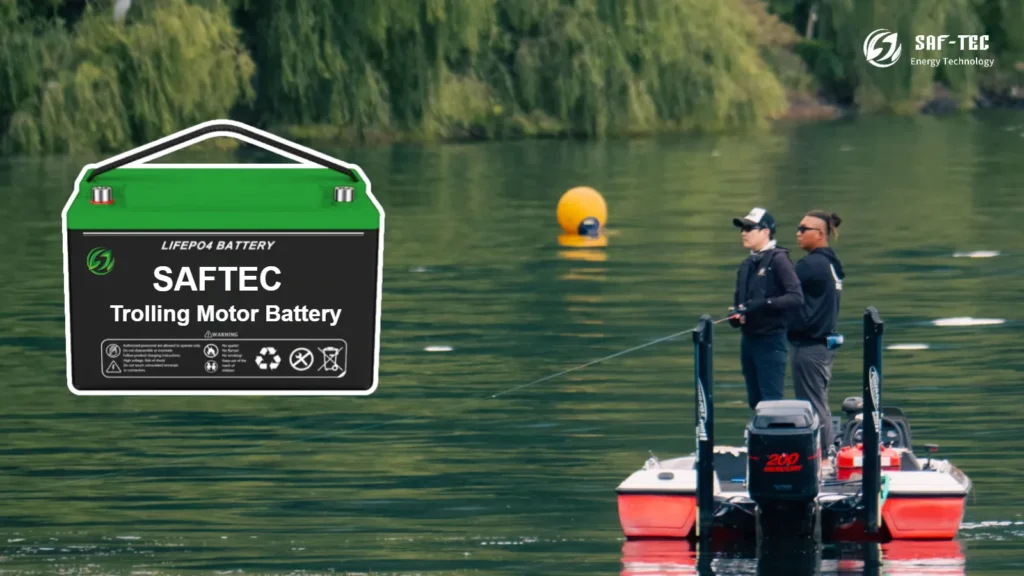
Best Lithium Battery Setups by Motor Voltage
| Motor system | Starting configuration | Key decision |
|---|---|---|
| 12V | One 12V-class deep-cycle LiFePO4 pack | Match capacity and discharge current to the trip and motor. |
| 24V | One 24V-class pack or two approved 12V packs in series | Compare space, wiring and charging arrangements. |
| 36V | One 36V-class pack or three approved 12V packs in series | Check current demand, installation and charger fit. |
These are starting points, not fixed rules for kayaks, pontoons or bass boats. Check the specific motor manual first: Lowrance Ghost, for example, accepts a 24V or 36V system, while other models have different requirements. A 36V pack cannot be treated as an upgrade for a 12V-only motor.
A compact pack may appeal for a kayak with little battery space; a bass boat using position-holding features in wind may need a larger energy allowance. Neither boat type determines battery voltage. That comes from the motor, while capacity follows the expected duty. If you are still choosing the motor, read our top trolling motor brands guide before deciding on its battery.
What Makes a Lithium Trolling Motor Battery the Best Fit?
Voltage: Verify the motor’s permitted operating range, including the pack’s voltage when fully charged. Nominal voltage alone is incomplete.
BMS current: The battery management system must support the motor’s maximum continuous draw and applicable short-duration demand. Do not guess battery current from thrust in pounds or assume that high Ah means high output current.
Usable energy: Compare watt-hours across voltages. A nominal 12.8V 100Ah LiFePO4 pack holds about 1,280Wh; a nominal 25.6V 100Ah pack holds about 2,560Wh. Neither figure promises a particular runtime. Wind, current, throttle use and battery limits matter. For the calculation, see our trolling motor battery sizing guide.
Charging: Match the onboard or shore charger to the final pack. For charging in freezing conditions, agree on a suitable low-temperature charging strategy rather than assuming every lithium pack can accept a charge.
Physical fit: Check compartment dimensions, restraints, terminals and cable routing. Specify the enclosure for the boat’s installation conditions; “marine battery” on a label is not a fit test.
The best choice is the pack that passes all five checks for the intended motor and boat, not simply the lightest or largest one.
One 24V/36V Pack or Several 12V Batteries?
An integrated higher-voltage pack reduces separate cases and interconnects. It may suit a new boat design, provided its size, weight and charger are approved.
Series-connected 12V modules may suit existing battery spaces. Two in series make a 24V-class bank; three make a 36V-class bank. Series raises voltage but does not add Ah: two nominal 12.8V 100Ah packs form a nominal 25.6V 100Ah bank. The modules must be explicitly approved for series operation, with compatible BMS behavior and a suitable charging plan.
Neither architecture is automatically best. Select one for the actual compartment, charging layout and service requirements. Our 24V trolling motor battery guide goes deeper into the wiring.
Turn the Choice into a Repeatable OEM Specification
For a boat builder or distributor, “best” must also mean a battery design that can be ordered consistently. Identify the target motor models and operating conditions, then agree on an electrical specification, enclosure drawing, connections and charging interface.
Check a sample in the intended installation: physical fit, motor operation under representative loads and charging behavior. Record any change before approving batch production. Specify which drawing and component revision the sample represents, so a later shipment can be checked against the same agreed design.
If one design will serve several motor models, check it against each model; shared nominal voltage is not proof of compatibility. Our marine lithium battery page covers other onboard battery applications.
Build a Trolling Motor Battery for Your Product Line
SAFTEC manufactures custom LiFePO4 batteries for trolling motor brands, boat builders and distributors. We discuss 12V, 24V and 36V-class projects for sample approval and batch supply.
Send the motor model, intended application and estimated order volume. Include a drawing or existing specification if available; we can clarify the remaining details together. See our trolling motor battery manufacturing page or contact SAFTEC about your project.
FAQ
Can a trolling motor lithium battery also start the outboard?
Do not assume so. The battery must be specifically designed and approved for that engine’s starting requirements. A deep-cycle trolling motor pack should be treated as a separate application unless the complete system is approved for both.
Should a fish finder share the trolling motor battery?
That depends on the fish finder’s voltage, the boat wiring and possible electrical interference. Some installations use a dedicated electronics supply. Check both devices before combining them on one bank.
Will switching from lead-acid to lithium affect boat balance?
It can. Replacing several heavy batteries changes weight distribution and may change trim. Check the completed installation, especially on small boats or when relocating the battery.
Can SAFTEC supply batteries under our own brand?
Yes. Private-label identification and packaging can be included in a project-based batch specification. The final configuration and order terms are agreed before production.